
Jupyter Notebook
Download notebook (.ipynb)
Output Output Output Output Output Output
Output Output Output Output
import torch
import torch.nn.functional as F
import matplotlib.pyplot as plt # for making figures
%matplotlib inline# read in all the words
words = open('names.txt', 'r').read().splitlines()
words[:8]['emma', 'olivia', 'ava', 'isabella', 'sophia', 'charlotte', 'mia', 'amelia']len(words)32033# build the vocabulary of characters and mappings to/from integers
chars = sorted(list(set(''.join(words))))
stoi = {s:i+1 for i,s in enumerate(chars)}
stoi['.'] = 0
itos = {i:s for s,i in stoi.items()}
vocab_size = len(itos)
print(itos)
print(vocab_size){1: 'a', 2: 'b', 3: 'c', 4: 'd', 5: 'e', 6: 'f', 7: 'g', 8: 'h', 9: 'i', 10: 'j', 11: 'k', 12: 'l', 13: 'm', 14: 'n', 15: 'o', 16: 'p', 17: 'q', 18: 'r', 19: 's', 20: 't', 21: 'u', 22: 'v', 23: 'w', 24: 'x', 25: 'y', 26: 'z', 0: '.'}
27# build the dataset
block_size = 3 # context length: how many characters do we take to predict the next one?
def build_dataset(words):
X, Y = [], []
for w in words:
context = [0] * block_size
for ch in w + '.':
ix = stoi[ch]
X.append(context)
Y.append(ix)
context = context[1:] + [ix] # crop and append
X = torch.tensor(X)
Y = torch.tensor(Y)
print(X.shape, Y.shape)
return X, Y
import random
random.seed(42)
random.shuffle(words)
n1 = int(0.8*len(words))
n2 = int(0.9*len(words))
Xtr, Ytr = build_dataset(words[:n1]) # 80%
Xdev, Ydev = build_dataset(words[n1:n2]) # 10%
Xte, Yte = build_dataset(words[n2:]) # 10%torch.Size([182625, 3]) torch.Size([182625])
torch.Size([22655, 3]) torch.Size([22655])
torch.Size([22866, 3]) torch.Size([22866])# MLP revisited
n_embd = 10 # the dimensionality of the character embedding vectors
n_hidden = 200 # the number of neurons in the hidden layer of the MLP
g = torch.Generator().manual_seed(2147483647) # for reproducibility
C = torch.randn((vocab_size, n_embd), generator=g)
W1 = torch.randn((n_embd * block_size, n_hidden), generator=g) * (5/3)/((n_embd * block_size)**0.5) #* 0.2
#b1 = torch.randn(n_hidden, generator=g) * 0.01
W2 = torch.randn((n_hidden, vocab_size), generator=g) * 0.01
b2 = torch.randn(vocab_size, generator=g) * 0
# BatchNorm parameters
bngain = torch.ones((1, n_hidden))
bnbias = torch.zeros((1, n_hidden))
bnmean_running = torch.zeros((1, n_hidden))
bnstd_running = torch.ones((1, n_hidden))
parameters = [C, W1, W2, b2, bngain, bnbias]
print(sum(p.nelement() for p in parameters)) # number of parameters in total
for p in parameters:
p.requires_grad = True11897# same optimization as last time
max_steps = 200000
batch_size = 32
lossi = []
for i in range(max_steps):
# minibatch construct
ix = torch.randint(0, Xtr.shape[0], (batch_size,), generator=g)
Xb, Yb = Xtr[ix], Ytr[ix] # batch X,Y
# forward pass
emb = C[Xb] # embed the characters into vectors
embcat = emb.view(emb.shape[0], -1) # concatenate the vectors
hpreact = embcat @ W1 #+ b1 # hidden layer pre-activation
#hpreact = bngain * (hpreact - hpreact.mean(0, keepdim=True)) / (hpreact.std(0, keepdim=True)) + bnbias #batch normalisation layer
#----------------
# BatchNorm layer
#----------------
bnmeani = hpreact.mean(0, keepdim=True)
bnstdi = hpreact.std(0, keepdim=True)
hpreact = bngain * (hpreact - bnmeani) / bnstdi + bnbias
with torch.no_grad():
bnmean_running = 0.999 * bnmean_running + 0.001 * bnmeani
bnstd_running = 0.999 * bnstd_running + 0.001 * bnstdi
#----------------
h = torch.tanh(hpreact) # hidden layer
logits = h @ W2 + b2 # output layer
loss = F.cross_entropy(logits, Yb) # loss function
# backward pass
for p in parameters:
p.grad = None
loss.backward()
# update
lr = 0.1 if i < 100000 else 0.01 # step learning rate decay
for p in parameters:
p.data += -lr * p.grad
# track stats
if i % 10000 == 0: # print every once in a while
print(f'{i:7d}/{max_steps:7d}: {loss.item():.4f}')
lossi.append(loss.log10().item())
#break #Add this while experienting so you dont have to print all the steps 0/ 200000: 3.2342
10000/ 200000: 1.8947
20000/ 200000: 1.8914
30000/ 200000: 1.9489
40000/ 200000: 2.1701
50000/ 200000: 2.0639
60000/ 200000: 2.0728
70000/ 200000: 2.3965
80000/ 200000: 2.4142
90000/ 200000: 2.2257
100000/ 200000: 2.2824
110000/ 200000: 1.8584
120000/ 200000: 2.1613
130000/ 200000: 1.9009
140000/ 200000: 1.8430
150000/ 200000: 2.3324
160000/ 200000: 2.2026
170000/ 200000: 1.6905
180000/ 200000: 1.9502
190000/ 200000: 2.0909Used for lecture : 00:12:59 fixing the saturated tanh
#plt.hist(h.view(-1).tolist(), 50)#plt.hist(hpreact.view(-1).tolist(), 50)#plt.figure(figsize=(20,10))
#plt.imshow(h.abs() > 0.99, cmap='gray', interpolation='nearest')End of Used for lecture : 00:12:59 fixing the saturated tanh
plt.plot(lossi)[<matplotlib.lines.Line2D at 0x21a782d9720>]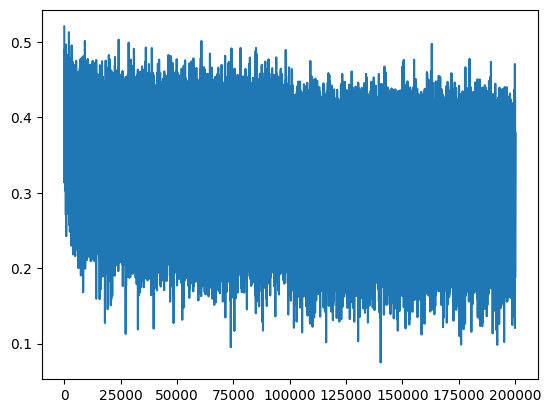
# # calibrate the batch norm at the end of training

# with torch.no_grad():
#   # pass the training set through
#   emb = C[Xtr]
#   embcat = emb.view(emb.shape[0], -1)
#   hpreact = embcat @ W1 # + b1
#   # measure the mean/std over the entire training set
#   bnmean = hpreact.mean(0, keepdim=True)
# bnstd = hpreact.std(0, keepdim=True)@torch.no_grad() # this decorator disables gradient tracking
def split_loss(split):
x,y = {
'train': (Xtr, Ytr),
'val': (Xdev, Ydev),
'test': (Xte, Yte),
}[split]
emb = C[x] # (N, block_size, n_embd)
embcat = emb.view(emb.shape[0], -1) # concat into (N, block_size * n_embd)
hpreact = embcat @ W1 #+ b1
#hpreact = bngain * (hpreact - hpreact.mean(0, keepdim=True)) / (hpreact.std(0, keepdim=True)) + bnbias #batch normalisation layer
hpreact = bngain * (hpreact - bnmean_running) / bnstd_running + bnbias
h = torch.tanh(hpreact) # (N, n_hidden)
logits = h @ W2 + b2 # (N, vocab_size)
loss = F.cross_entropy(logits, y)
print(split, loss.item())
split_loss('train')
split_loss('val')train 2.037672996520996
val 2.107128620147705#The initial loss value that we expect
-torch.tensor(1/27.0).log()tensor(3.2958)# sample from the model
g = torch.Generator().manual_seed(2147483647 + 10)
for _ in range(20):
out = []
context = [0] * block_size # initialize with all ...
while True:
# forward pass the neural net
emb = C[torch.tensor([context])] # (1,block_size,d)
h = torch.tanh(emb.view(1, -1) @ W1 + b1)
logits = h @ W2 + b2
probs = F.softmax(logits, dim=1)
# sample from the distribution
ix = torch.multinomial(probs, num_samples=1, generator=g).item()
context = context[1:] + [ix]
out.append(ix)
# if we sample the special '.' token, break
if ix == 0:
break
print(''.join(itos[i] for i in out)) # decode and print the generated wordmora.
mayah.
see.
mel.
rylee.
emmadiejd.
leg.
adelyn.
elin.
shi.
jen.
eden.
estanar.
kayziquetta.
noshir.
roshiriel.
kendreth.
konnie.
casube.
ged.