
Introduction to Agentic Workflows
What is Agentic AI?
An agentic AI workflow is a process where an LLM based app executes multiple steps to complete a task.
Knowing how to decompose the task into steps and how to build the components to execute the individual steps turns out to be a tricky but important skill that will determine our ability to build agentic workflows for a huge range of exciting applications.
Lets say we are building a comprehensive research agent- So when asked a query (like, how can we complete with SpaceX?) this agent starts with planning out what research to use, including calling a web search engine to download some web pages, and then to synthesize and rank findings, draft an outline, have an editor-to-agent review for coherence, and then finally generate a comprehensive markdown report. So, the final output will be on building a new rocket company to compete with SpaceX with an intro, background, findings, and so on.
Now, one of the often-discussed areas of AI agents is how autonomous are they? What we read above was a relatively complex, highly autonomous Agentic AI workflow, but there are also other simpler workflows that are incredibly valuable.
Degrees of autonomy
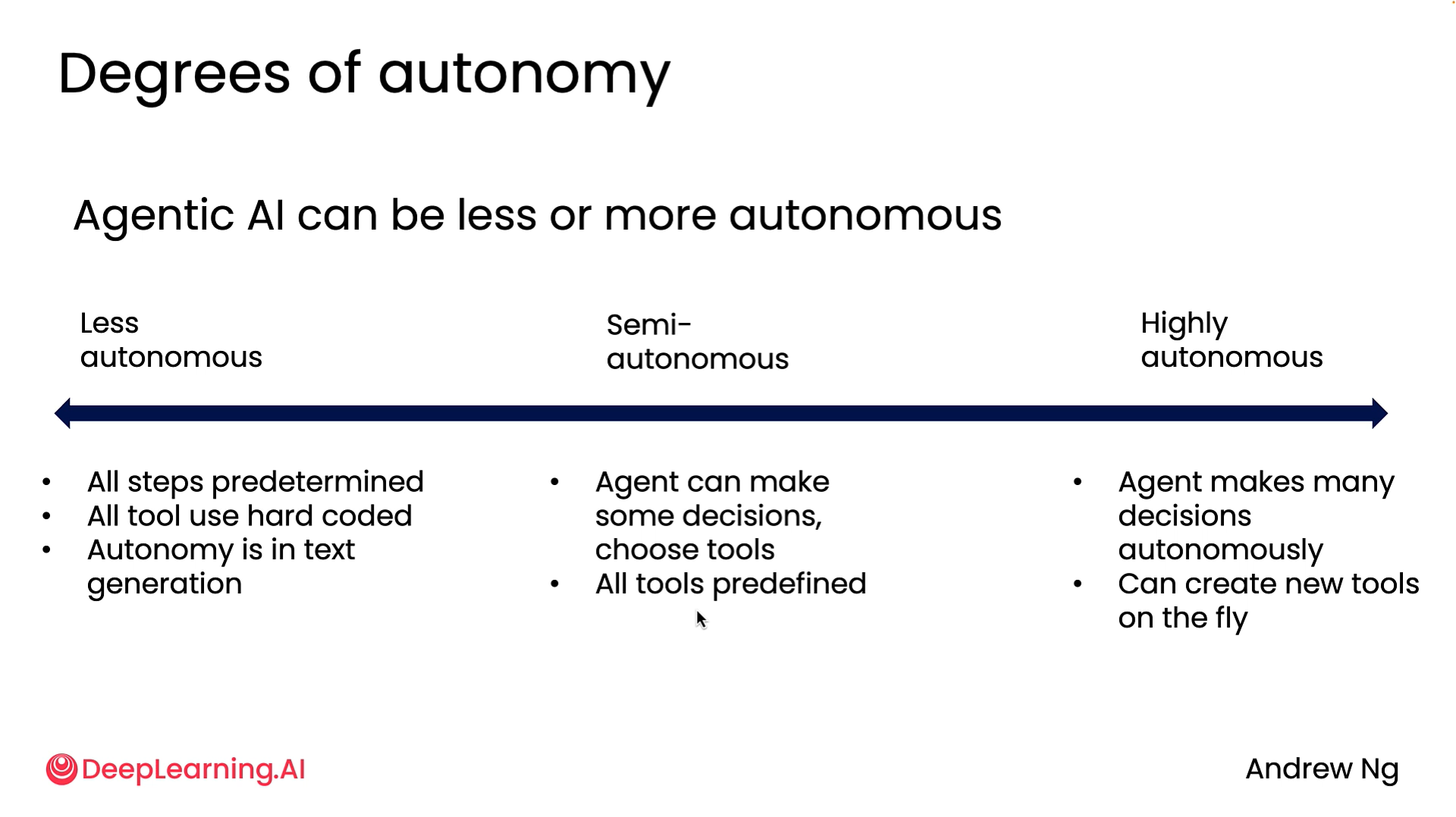
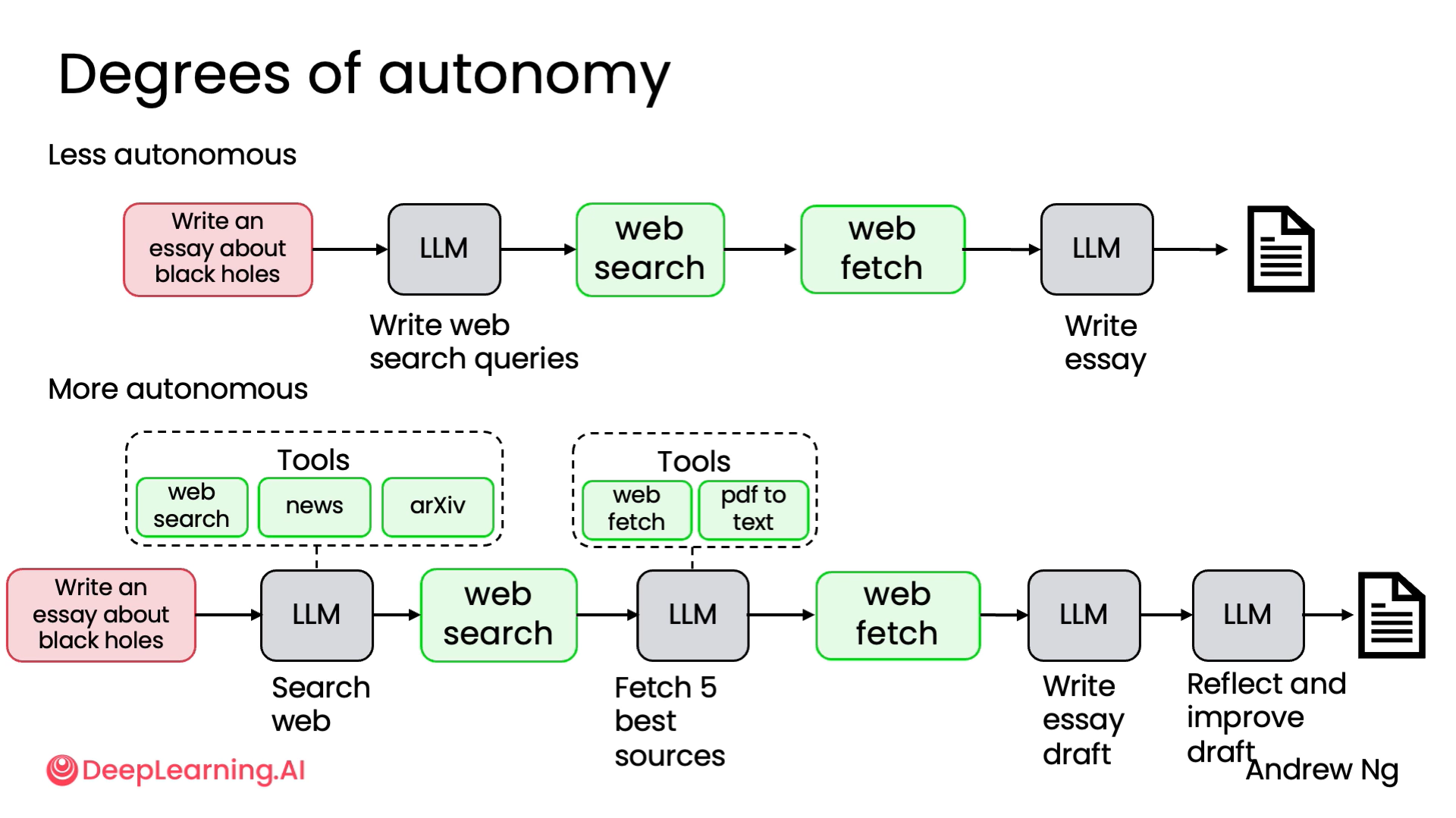
Keeping the above diagram in mind, You will find that there are tons of applications in the less autonomous end of the spectrum that are very valuable being built for tons of businesses today, and at the same time, there are also applications being worked on at the more highly autonomous end of the spectrum, but those are usually less easily controllable, a little bit more unpredictable, and also a lot of active research as well to figure out how to build these more highly autonomous agents.
Benefits of Agentic AI
I think the one biggest benefit of agentic workflows is that it allows you to do many tasks effectively that just previously were not possible. But there are other benefits as well, including parallelism (which we will talk about after the coding benchmark example) that lets you do certain things quite fast, as well as modularity that lets you combine the best of three components from many different places to build an effective workflow.
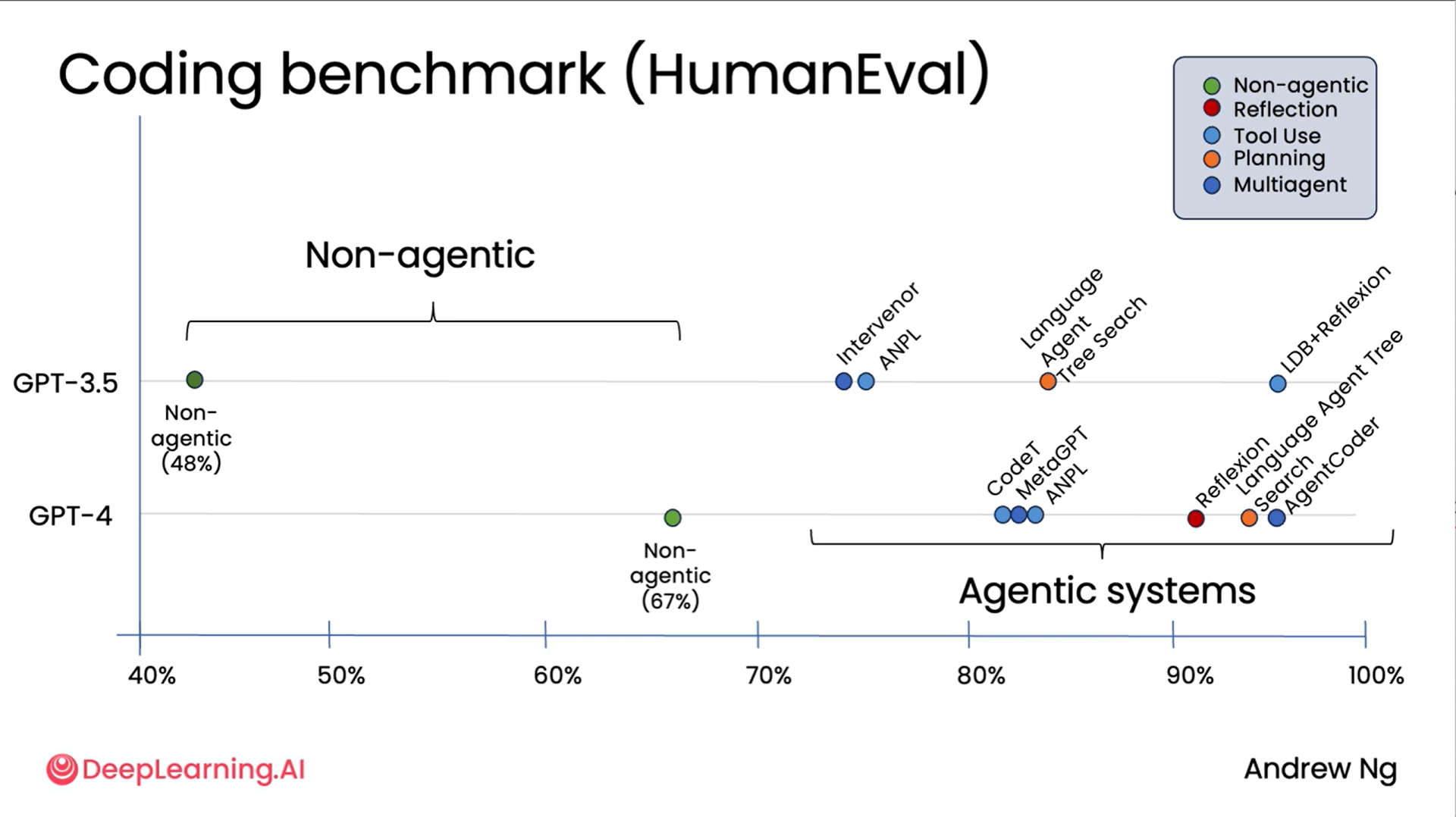
First comes Coding Benchmark: The diagram above shows us the data on a coding benchmark that tests the ability of different LLMs to write code to carry out certain tasks. The benchmark used in this case is called Human Eval. It turns out that GPT 3.5, if asked to write the code directly, gets 40% right on this benchmark. This is a positive k-metric. GPT 4 is a much better model. Its performance leaps to 67% with this also non-agentic workflow.
But it turns out that as large as the improvement was from GPT 3.5 to GPT 4, that improvement is dwarfed by what you can achieve by wrapping GPT 3.5 within an agentic workflow.
Using different agentic techniques (which we will learn more on later), you can prompt GPT 3.5 to write code and then maybe reflect on the code and figure out if you can improve it. And using techniques like that, you can actually get GPT 3.5 to get much higher levels of performance. And similarly, GPT 4 used in the context of an agentic workflow also does much better.
So even with today's best LLMs, an agentic workflow lets you get much better performance. And in fact, what we saw in this example was the improvement from one generation of model to another, which is huge, is still not as big a difference as implementing an agentic workflow on the previous generation of model.
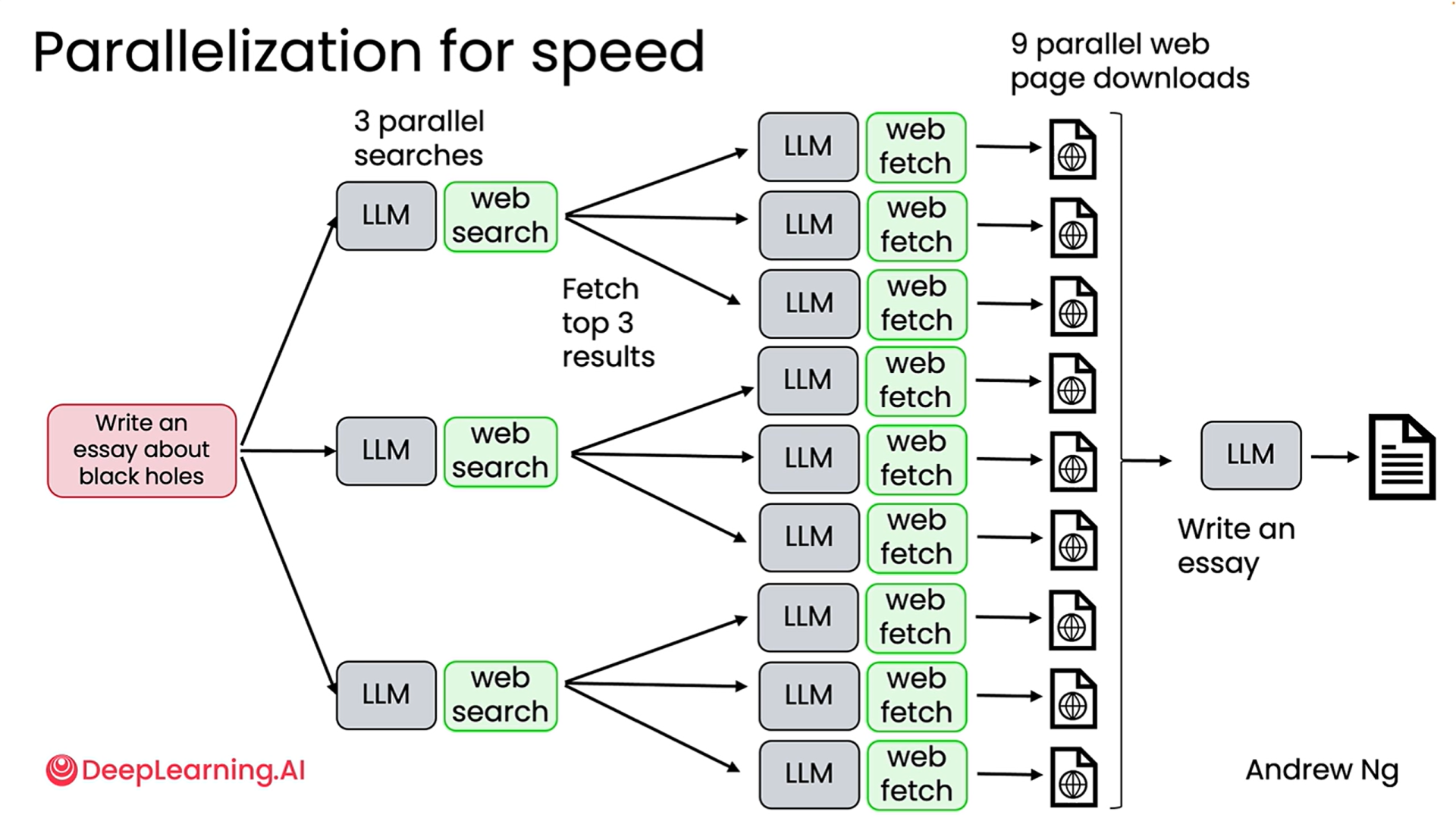
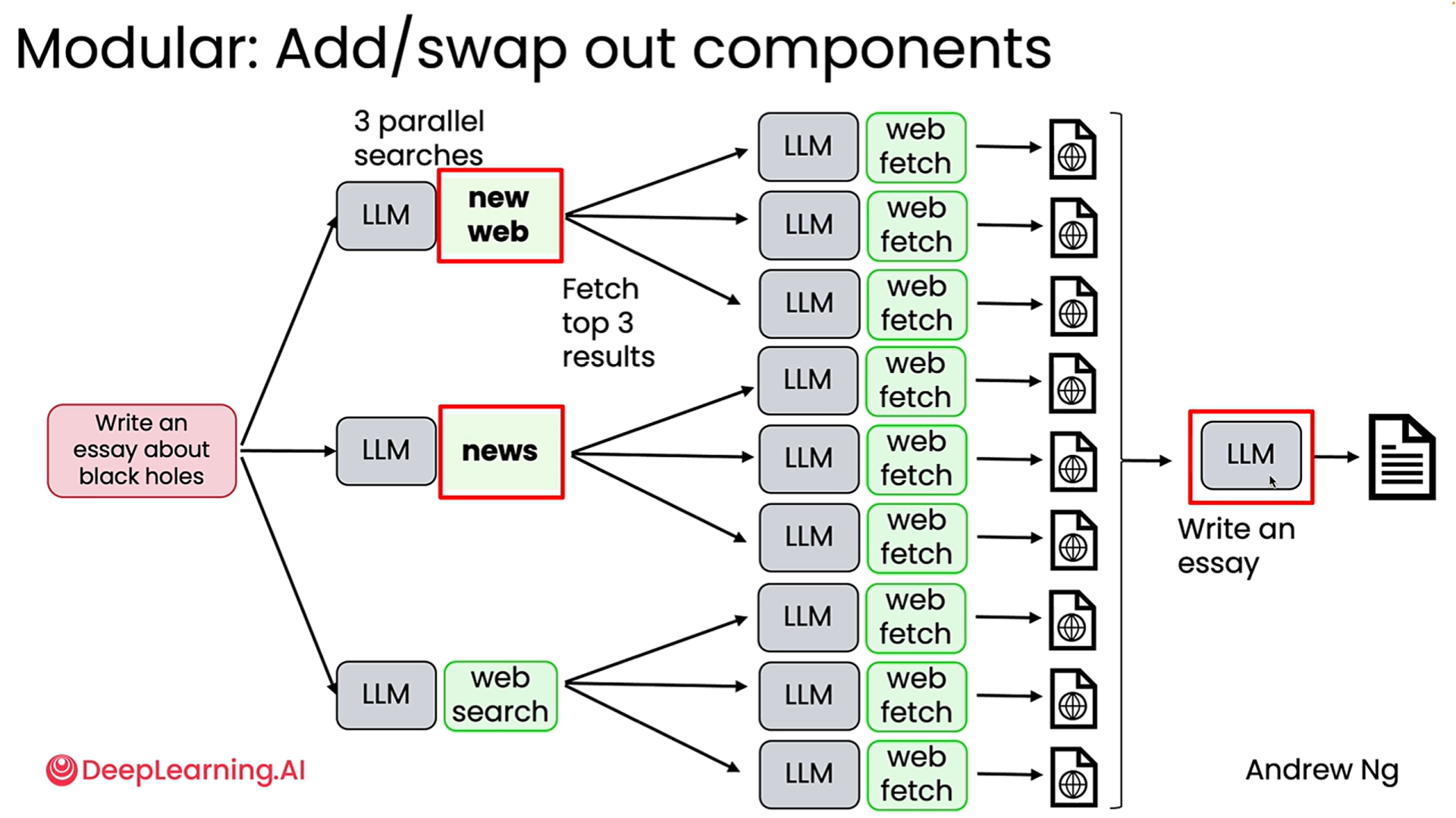
Next comes Parallelization: This is another benefit of using agentic workflows where they can parallelize some tasks and thus do certain things much faster than a human. The first diagram shows how it can do almost 9 web searches at once. Second diagram shows how we can experiment with it by changing the specific components like the search API or even trying out different LLMs rather than sticking with just one for all the different steps, to see which modifications can provide better outputs for our task.
Agentic AI Applications
Here we've seen the different types of agentic applications currently in use, like customer service etc. The main point to takeaway would be the below diagram which shows how easy/hard it is to build your agent based on what you have.
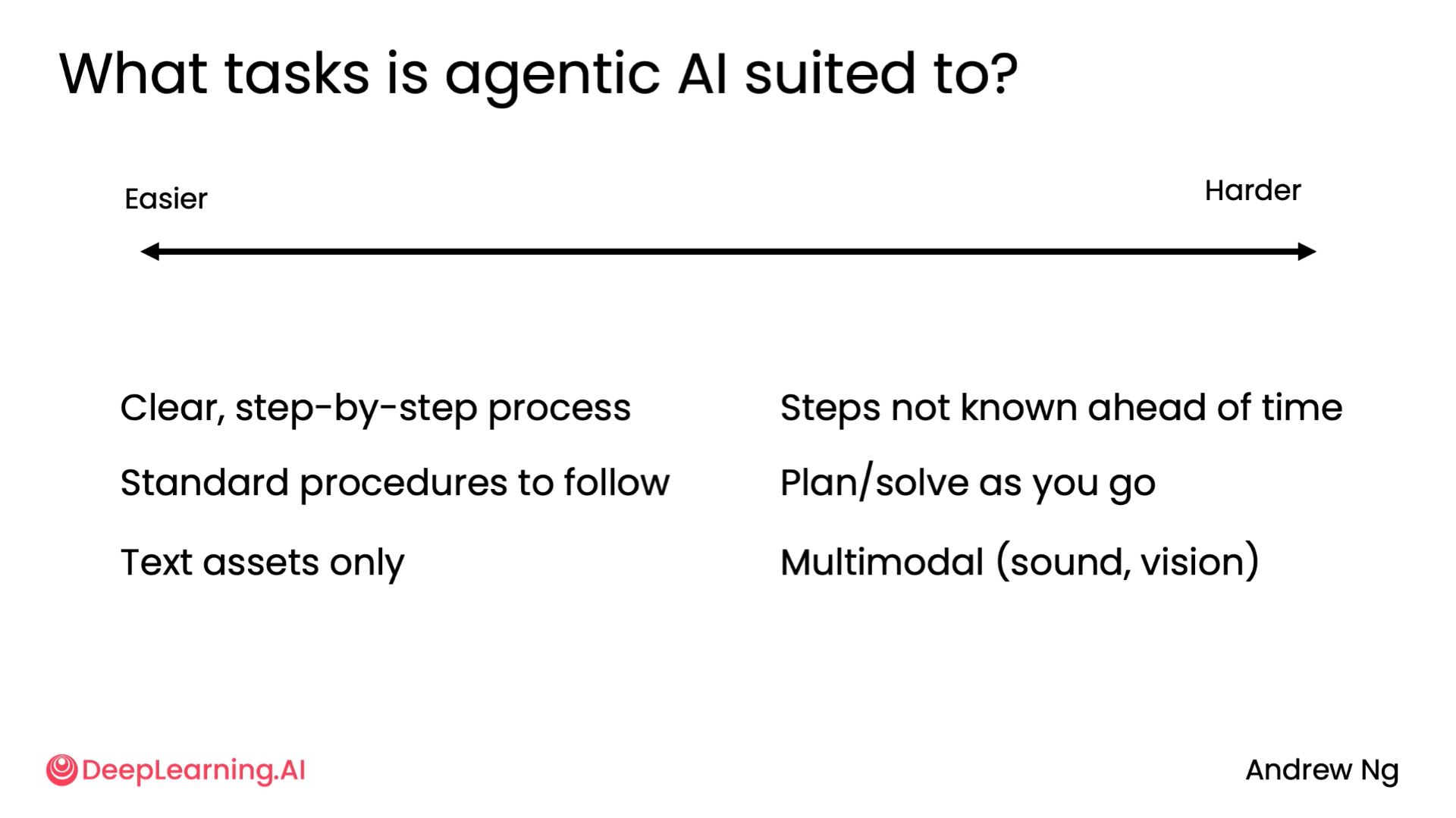
So, when implementing one of these things yourself, one of the most important skills is to look at a complex workflow and figure out what are the individual steps so you can implement an agentic workflow to execute those steps one at a time. And that is exactly what we will be looking at in Task decomposition.
Task decomposition
One of the key skills in building agentic workflows is to look at a bunch of stuff that maybe someone does and to identify the discrete steps that it could be implemented with.
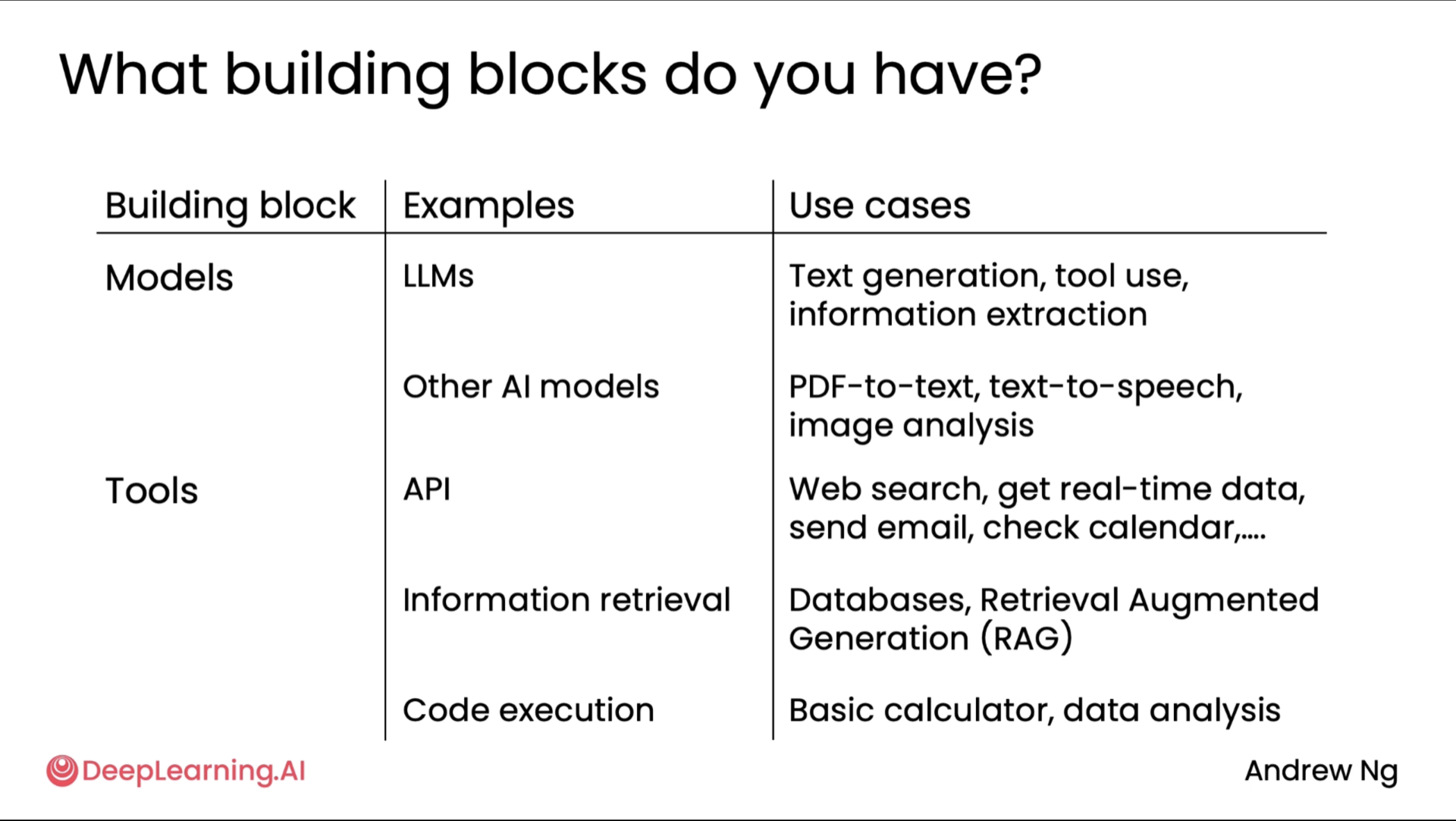
And when I'm looking at the individual discrete steps, one question I'm always asking myself is, can this step be implemented with either an LLM or with one of the tools such as an API or a function call that I have access to? And in case the answer is no, I'll then often ask myself, how would I as a human do this step? And is it possible to decompose this further or break this down into even smaller steps that then maybe is more amenable to implementation with an LLM or with one of the software tools that I have?
Evaluation (evals)
"Your ability to drive evals for your agentic workflow makes a huge difference in your ability to build them effectively."
There are some simple ways to evaluate your agent like:
- You can write codes to evaluate objective criteria, such as 'did it mention a competitor or not'.
- Using an LLM as a judge for more subjective criteria such as 'what's the quality of this essay'.
But later, we will learn about two major types of evals:
- One is end-to-end, where you measure the output quality of the entire agent.
- Other is component level evals, where you measure the quality of the output of a single step in the agentic workflow.
It turns out that these are useful for driving different parts of your development process.
There is another method apart from this where you just examine the intermediate outputs - we call these the traces of the LLM, in order to understand where it is falling short of my expectations. And we call this error analysis, where we just read through the intermediate outputs of every single step to try to spot opportunities for improvement.
Agentic design patterns
- Reflection
- Tool Use
- Planning
- Multi-agent collaboration
(There were some great slides which showed examples on the above, feel free to watch that. But since we will be diving deep into this as well, I didn't want to get hung around in just the overview stuff for now).
Update: Also damn, the quiz was slightly more tricky than I thought it would be lol. But its done and I also tried out the research agent which was already developed by sensei, you can checkout it's output here, very impressive actually. Now we move on!
Copyright © 2024-2026 Muhammed Muzzammil Shah