
Reflection Design Pattern
Reflection to improve outputs of task
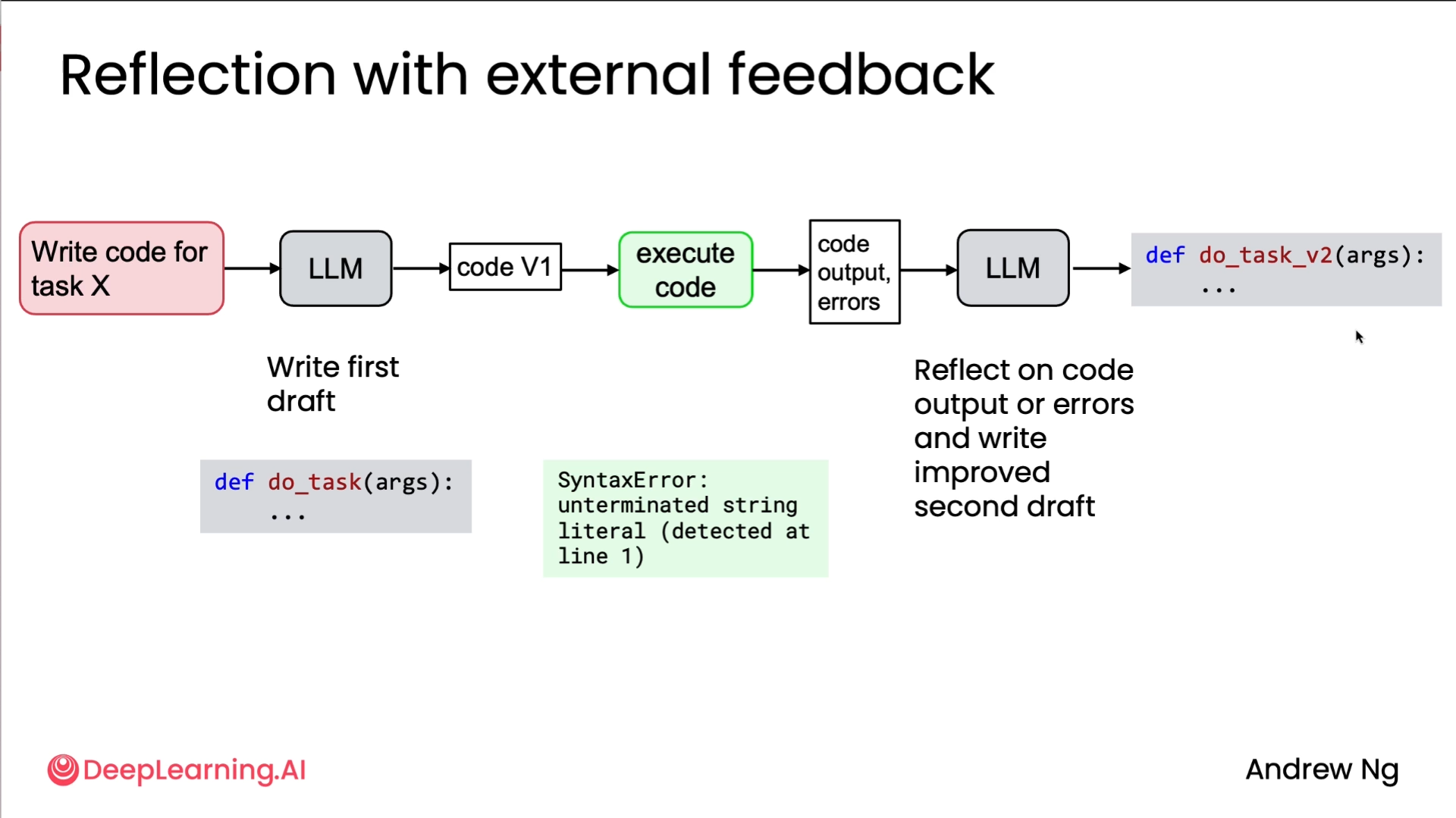
One design consideration to keep in mind is, reflection is much more powerful when there is new additional external information that you can ingest into the reflection process.
For example, if you can run the code and have that code output or error messages as an additional input to the reflection step, that really lets the LLM reflect much more deeply and figure out what may be going wrong. This results in a much better second version of the code than if there wasn't this external information that you can ingest. So one thing to keep in mind, whenever reflection has an opportunity to get additional information, that makes it much more powerful.
The attached diagram shows exactly that, where rather than just feeding the provided code from step 1 back into reflection, we execute it ourselves and give additional data for reflection, therefore providing us with a better output.
Reflection does not make an LLM always get everything right 100% of the time, but it can often give it maybe a modest bump in performance.
Why not just direct generation?
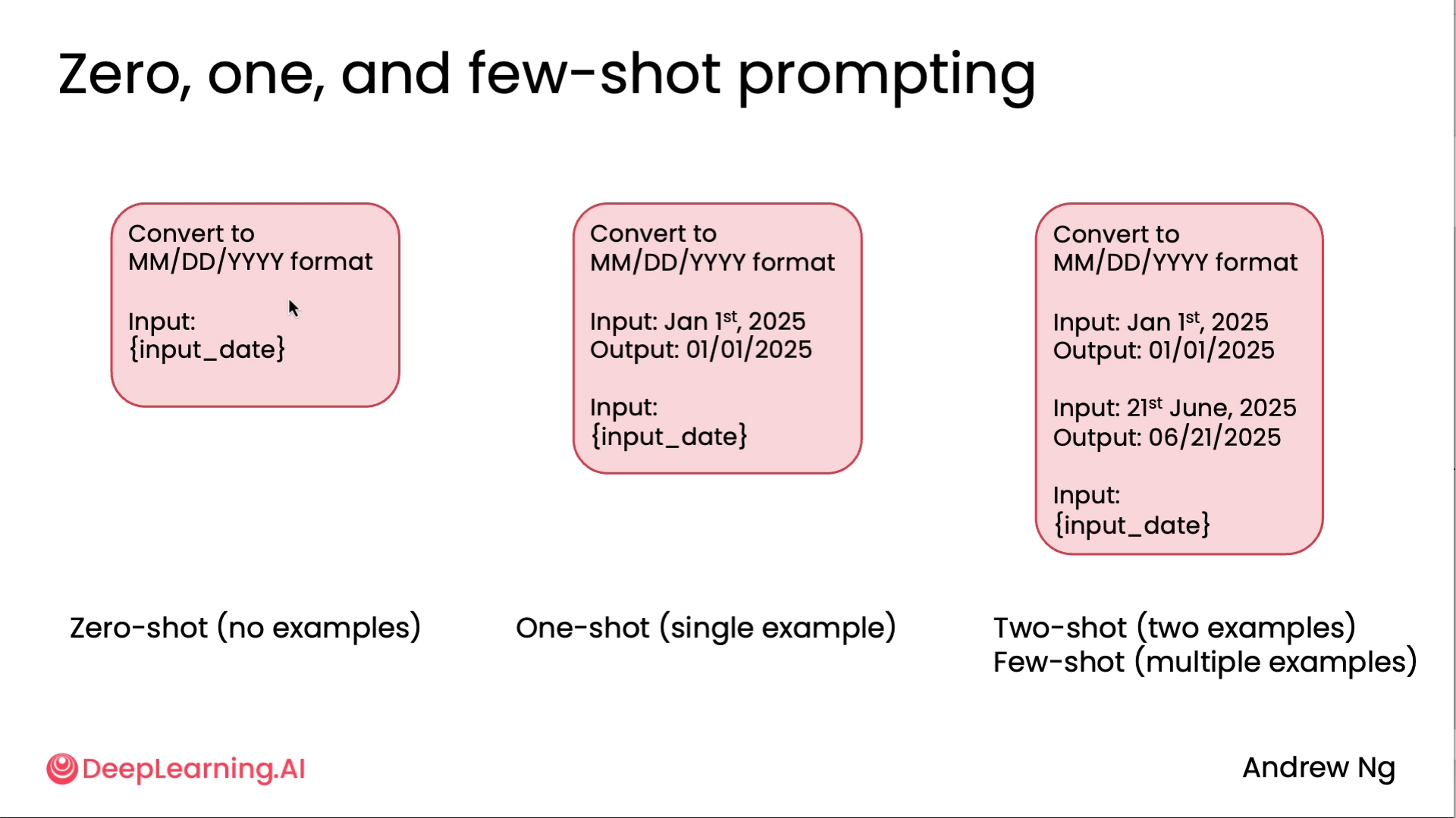
Direct generation aka Zero shot prompting. There are different types of how we can provide all possible information to the LLM.
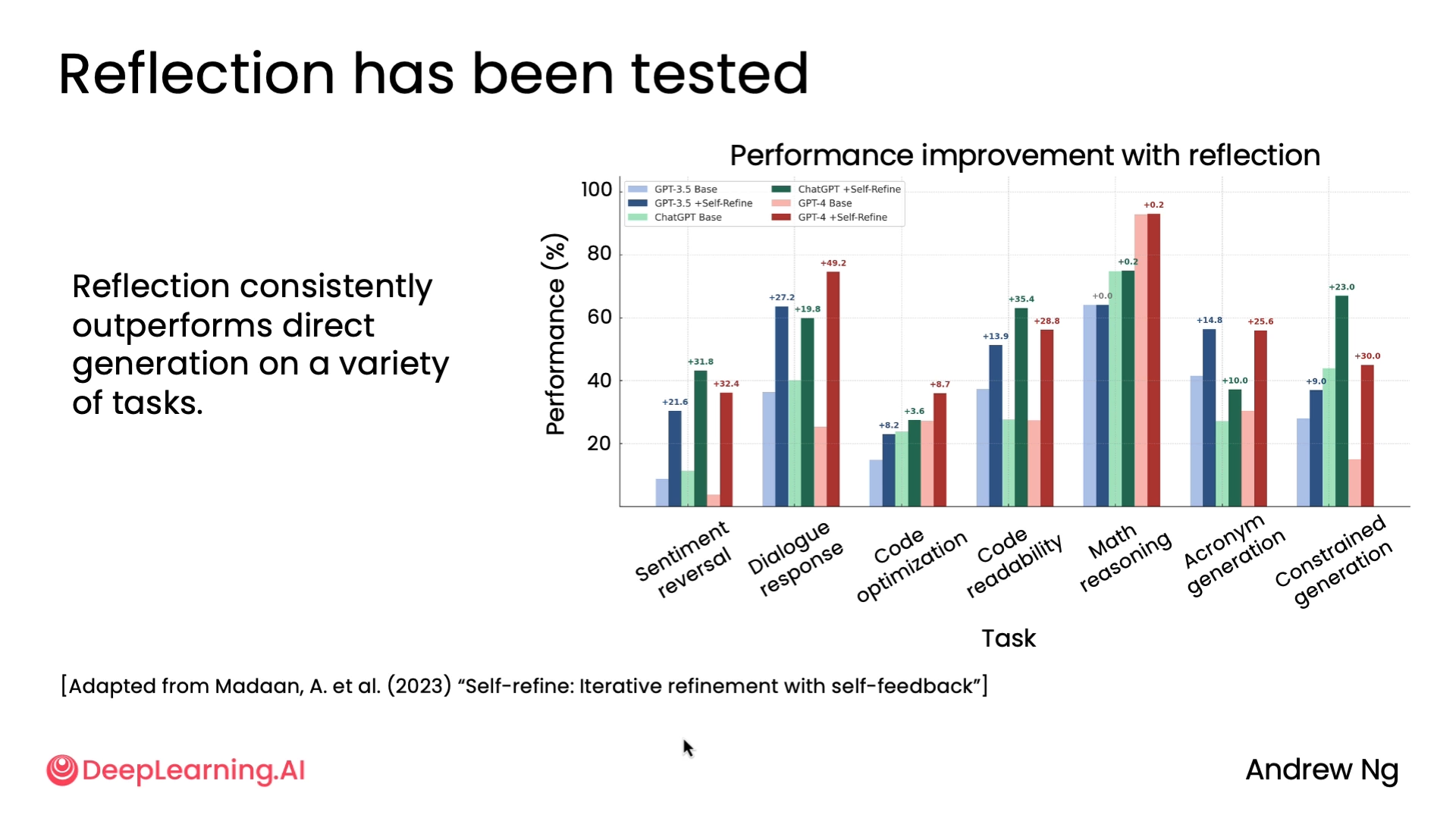
Below diagram is adapted from the research paper by Madaan and others, and this shows a range of different tasks being implemented with different models and with and without reflection. The way to read this diagram is to look at these pairs of adjacent light followed by dark-colored bars, where the light bar shows zero-shot prompting and the dark bar shows the same model but with reflection.
So some tips for writing reflection prompts: It helps to clearly indicate that you want it to review or to reflect on the first draft of the output. And if you can specify a clear set of criteria/instructions in points, such as whether the domain name is easy to pronounce and whether it may have negative connotations or for email, check the tone and verify the facts. Then that guides the LLM better in reflecting and critiquing on the criteria that you care the most about.
Chart generation workflow
This is a fun example where we'll start to look at multi-modal inputs and outputs. We'll have an algorithm reflect on an image being generated or a chart being generated.
Code
The code for this is in the Reflection notebooks.
One thing you may find is that sometimes using a reasoning model for reflection may work better than a non-reasoning model.
Now, when you're building an application, one thing you may be wondering is, does reflection actually improve performance on your specific application? From various studies, reflection improves performance by a little bit on some, by a lot on some others, and maybe barely any at all on some other applications.
And so it'll be useful to understand its impact on your application and also give you guidance on how to tune either the initial generation or the reflection prompt to try to get better performance.
Evaluating impact of reflection
Reflection often improves the performance of the system, but before I commit to keeping it, I would usually want to double check how much it actually improves the performance, because it does slow down the system a little bit by needing to take an extra step.
Let's take a look at evals for reflection workflows.
Let's look at an example of using reflection to improve the database query that an LLM writes to fetch data to answer questions. Let's say you run a retail store, and you may get questions like, which color product has the highest total sales? To answer a question like this, you might have an LLM generate a database query. After writing a database query, instead of using that directly to fetch information from the database, you may have an LLM, the same or different LLM, reflect on the version one database query and update it to maybe an improved one, and then execute that database query against the database to fetch information to finally have an LLM answer the question.
So the question is, does using a second LLM to reflect and improve on the database or SQL query actually improve the final output? In order to evaluate this, I might collect a set of questions or set of prompts together with ground truth answers. So maybe one would be, how many items are sold in May 2025? What's the most expensive item in the inventory? How many styles are carried in my store? And I write down for maybe 10, 15 prompts, the ground truth answer. Then you can run this workflow without reflection. So without reflection would mean to take the SQL query generated by the first LLM and to just see what answer it gives. And with reflection would mean to take the database query generated after the second LLM has reflected on it to see what answer that fetches from the database. And then we can measure the percentage of correct answers from no reflection and with reflection. In this example, no reflection gets the answers right 87% of the time, with reflection gets it right 95% of the time. And this would suggest that reflection is meaningfully improving the quality of the database queries I'm able to get to pull out the correct answer.
One thing that developers often end up doing as well is rewrite the reflection prompt. So for example, do you want to add to reflection prompt an instruction to make the database query run faster or make it clearer? Or you may just have different ideas for how to rewrite either the initial generation prompt or the reflection prompt. Once you put in place evals like this, you can quickly try out different ideas for these prompts and measure the percentage correct your system has as you change the prompts in order to get a sense of which prompts work best for your application. So if you're trying out a lot of prompts, building evals is important.
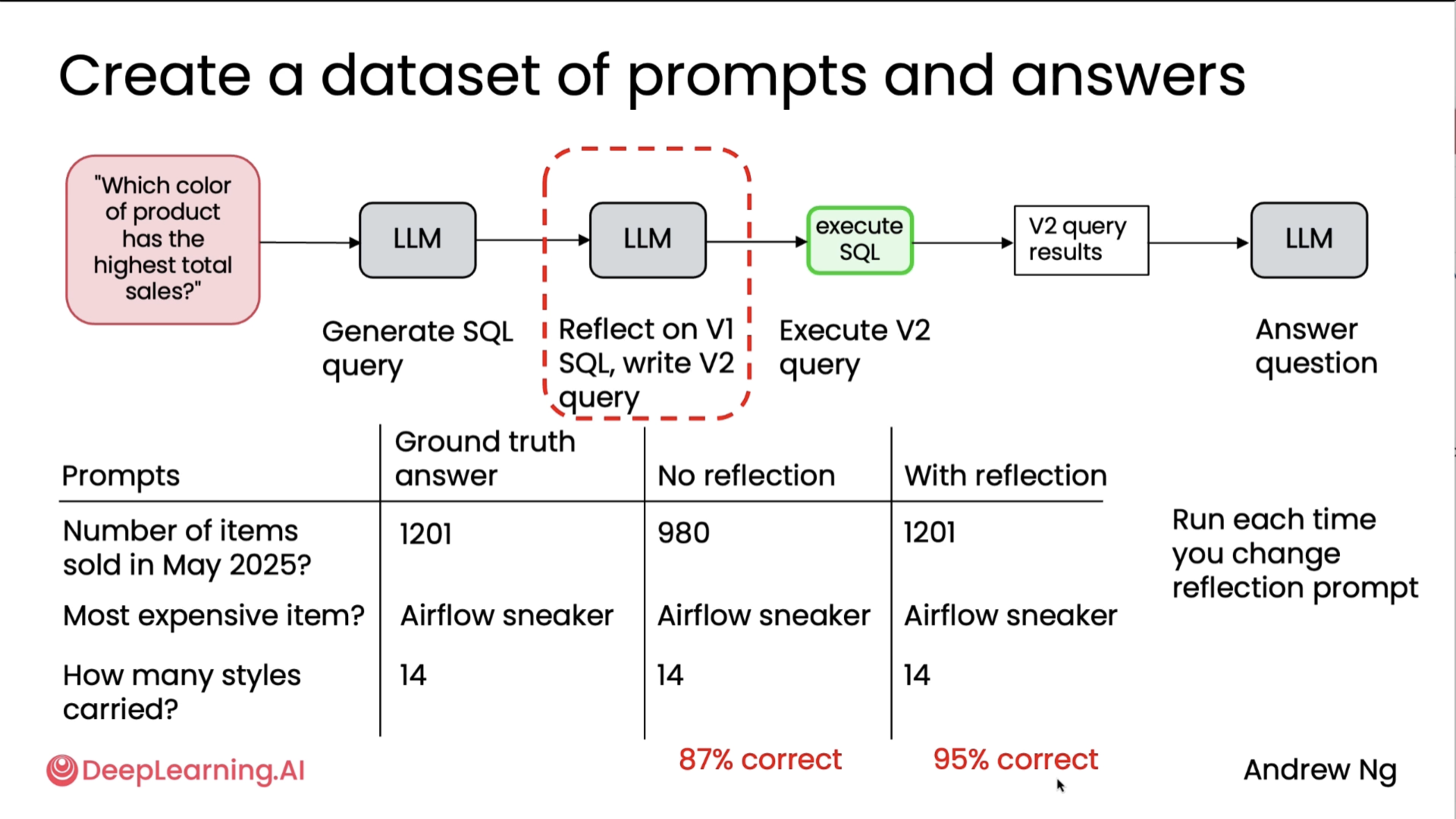
It really helps you have a systematic way to choose between the different prompts you might be considering. But this example is one of when you can use objective evals because there is a right answer. The number of items sold was 1,301 and the answer is either right or wrong. How about applications where you need more subjective rather than objective evaluations? In the plotting example that we saw in the previous example, without reflection we had the stack bar graph, with reflection we had this graph. But how do we know which plot is actually better? Measuring which of those plots is better is more of a subjective criteria rather than a purely black and white objective criteria. So for these more subjective criteria, one thing you might do is use an LLM as a judge.
And maybe a basic approach to do this might be to feed both plots into an LLM, a multi-modal LLM that can accept two images as input, and just ask it which image is better. It turns out this doesn't work that well as it turns out that there's some known issues of using LLMs to compare two inputs to tell you which one is better. First, it turns out the answers are often not very good. It could be sensitive to the exact wording of the prompt of the LLM as a judge, and sometimes the rank ordering doesn't correspond that well to human expert judgment. And one manifestation of this is many LLMs will have a position bias. Many LLMs, it turns out, will often pick the first option more often than the second option.
So, Instead of asking an LLMs to compare a pair of inputs, grading with a rubric can give more consistent results. So, for example, you might prompt an LLM to tell it, given a single image, assess the attached image against the quality rubric, and the rubric or grading criteria may have clear criteria like does the plot have a clear title, are the access labels present, is it an appropriate chart type, and so on, with a handful of criteria like this. Even here, it turns out that instead of asking the LLM to grade something on a scale of 1 to 5, which it tends not to be well calibrated on, if you instead give it, say, 5 binary criteria, 5-0-1 criteria, and have it give 5 binary scores, and you add up those scores to get the number from 1 to 5 or 1 to 10 if you have 10 binary criteria, that tends to give more consistent results.
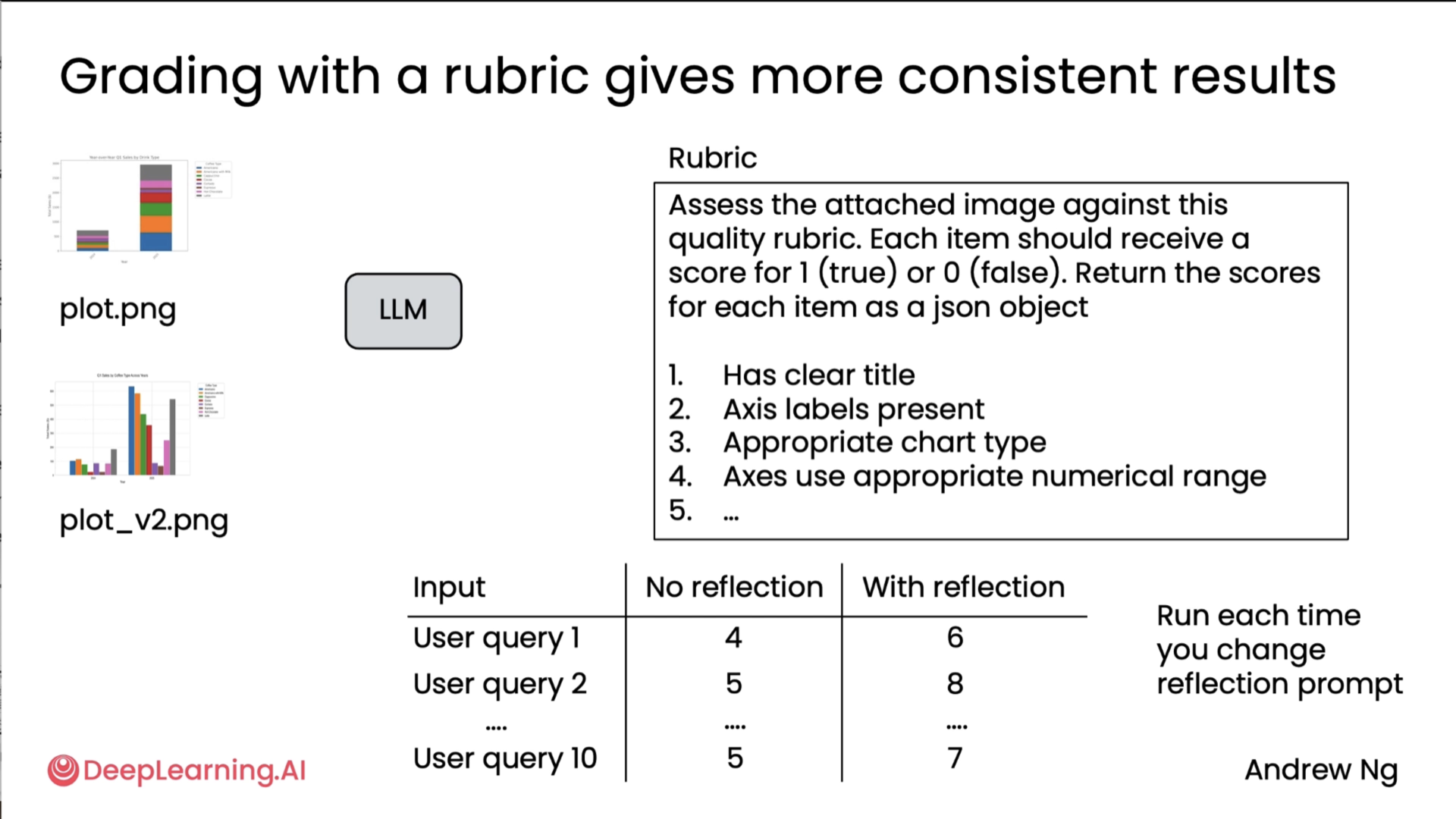
And so if we're to gather a handful, say 10-15 user queries for different visualizations that the user may want to have of the coffee machine sales, then you can have it generate images without reflection or generate images with reflection, and use a rubric like this to score each of the images to then check the degree to which or whether or not the images generated with reflection are really better than the ones without reflection. And then once you've built up a set of evals like this, if ever you want to change the initial generation prompt or you want to change the reflection prompt, you can also rerun this eval to see if, say, updating one of your prompts allows the system to generate images that scores more points according to this rubric. And so this too gives you a way to keep on tuning your prompts to get better and better performance.
What you may find when building evaluations for reflection or for other agentic workflows is that when there is an objective criteria, code-based evaluation is usually easier to manage. And in the example that we saw with the database query, we built up a database of ground truth examples and ground truth outputs and just wrote code to see how often the system generated the right answer in a really objective evaluation metric. In contrast for small subjective tasks, you might use an element as a judge but it usually takes a little bit more tuning, such as having to think through what rubric you may want to use to get the LLM as a judge to be well calibrated or to output reliable evals.
Using external feedback
The diagram below should clearly tell you why external feedback is important.
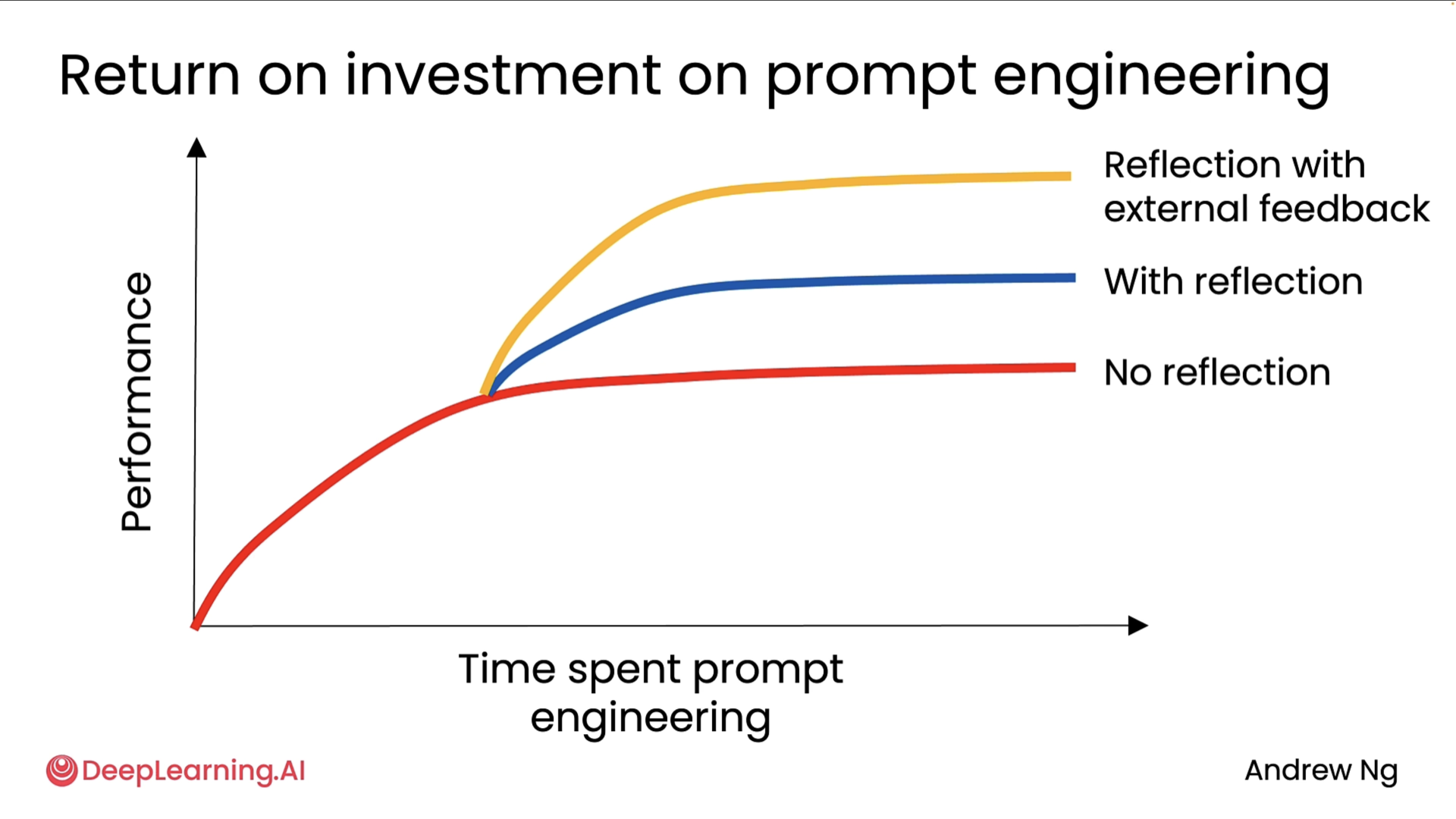
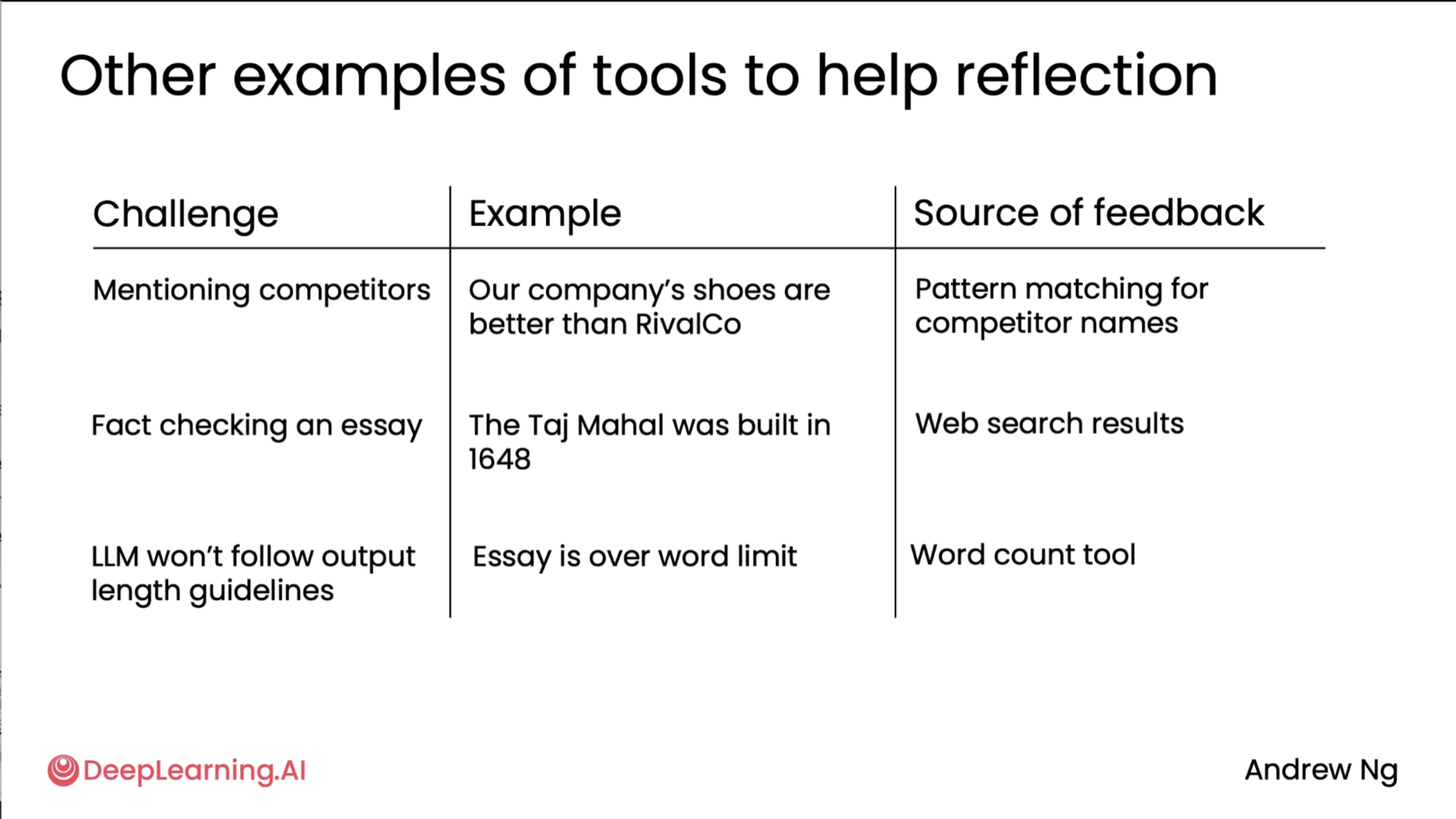
Finally, as we move on to tool calling, the below examples show where tools fit in to provide better results. So, Challenge -> Source of feedback (tool) need to solve it.
Copyright © 2024-2026 Muhammed Muzzammil Shah